They Just Showed Up
Before Title IX. Before women's teams existed. Some women didn't wait for the door to open — they found another way in. The untold story of Dorothy Anderson, Cyndy Meserve, and the pioneers who showed up before anyone thought to invite them.
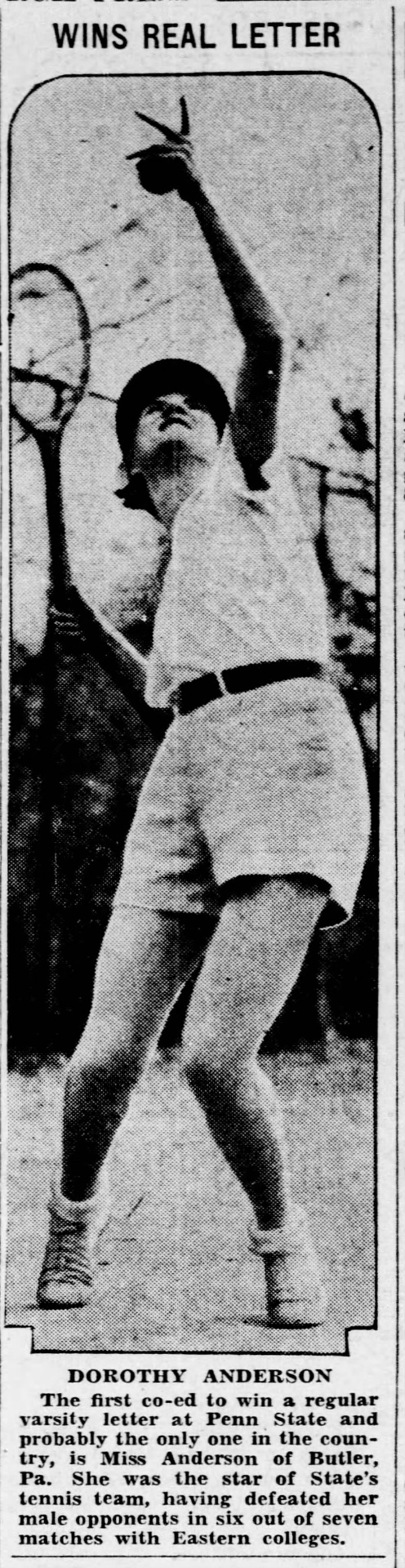
In 1931, Dorothy Anderson — a promising young tennis player from western Pennsylvania and the reigning Western Pennsylvania women's tennis champion — tried to earn a spot on the men's varsity tennis team at Carnegie Tech, today's Carnegie Mellon. The coach wanted her. Her teammates accepted her. The Dean of Women said no.
So Dorothy found another way in. Transferring to Penn State, she won a spot on the men's varsity team, competed on the team, and went out and beat most of her male opponents. In 1935, she earned a varsity letter. The Pittsburgh Sun-Telegraph reported that she was "believed to be the first woman ever to win her way to a position on an eastern college team." Her record that season: six wins, one loss — all against male opponents from Eastern colleges.
One of those wins came against Carnegie Tech, her former college. She defeated their player Charles Vukovich 4–6, 8–6, 6–0 — dropping the first set, then coming back to take the match. Penn State won the day 5–0.
She was, according to a 2020 study in the International Journal of the History of Sport, the only woman to earn a college varsity letter before 1964. Inspired by her example, women joined men's tennis teams at several other colleges across the region through the 1930s and '50s.
Forty Years Later, in Brooklyn
Forty years later, in 1974, an 18-year-old freshman from Livermore Falls, Maine walked into a gym at Pratt Institute in Brooklyn and signed up for basketball tryouts. Her name was Cyndy Meserve, and she thought she was trying out for the women's team.
Pratt didn't have a women's team.
When Coach Tony Missere explained this, Cyndy shrugged. She'd try out for the men's squad instead.
"It completely floored me," said Missere.
It shouldn't have. Cyndy made the 15-man roster. She was, according to her coach, the team's second-best foul shooter. When the season opened against Baruch College on November 29, 1974, Cyndy Meserve became the first woman to play on a men's basketball team in NCAA history. She played in 14 of 22 games. She went 8-for-8 from the foul line. The Maine legislature passed a resolution honoring her.
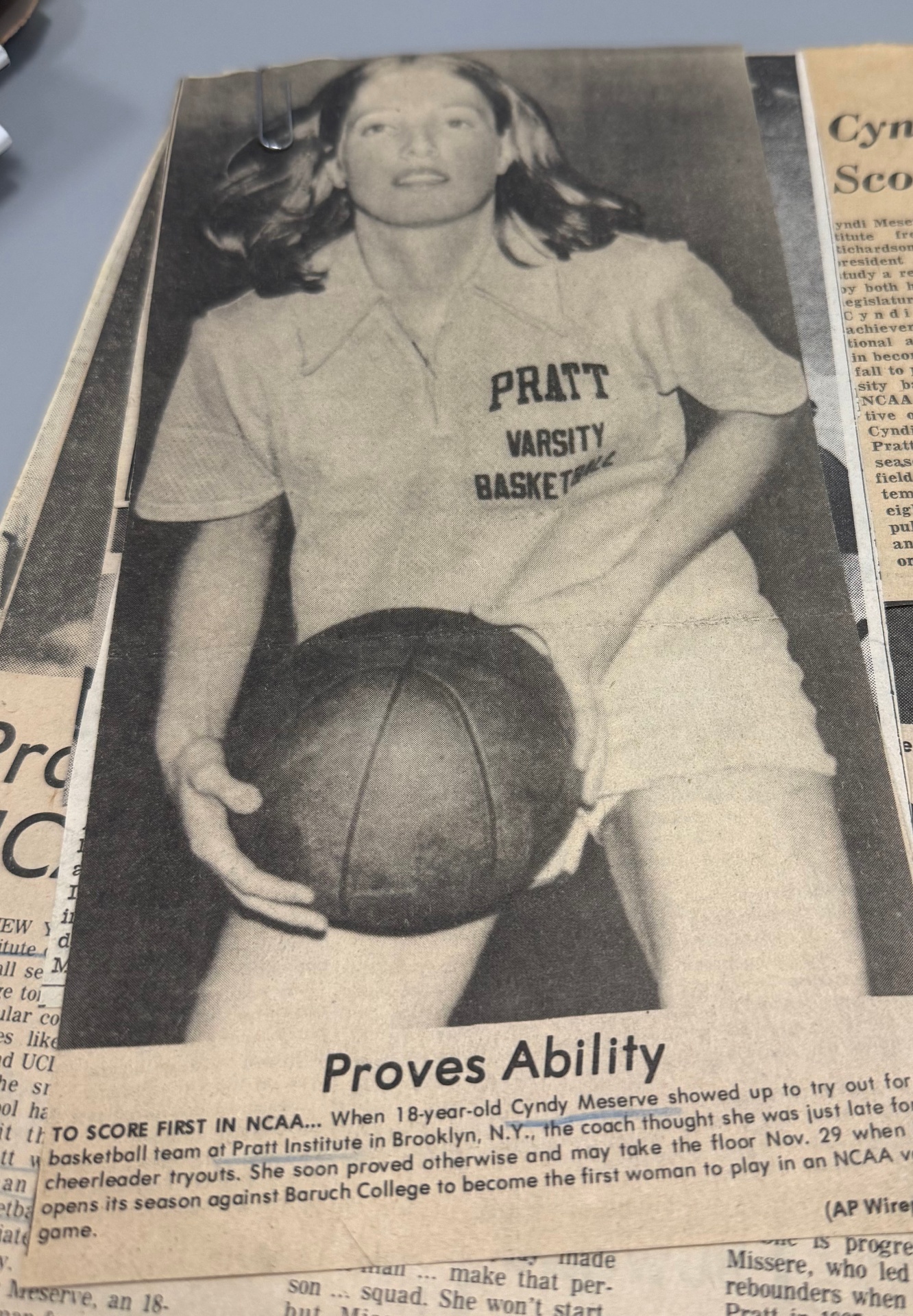
The AP Wirephoto of Cyndy in her Pratt uniform, basketball in hand, went out to newspapers across the country.
"We've gotten more publicity than any other basketball school in the nation," said Missere. "She has generated a lot of excitement."
Neither Dorothy Anderson nor Cyndy Meserve set out to make history. They just wanted to play. When the door was locked, they found another way in.
That pattern turns out to be everywhere, if you know where to look.
At Trinity, the Same Story
When I was digging through Trinity College's athletics history — interviewing 240 former athletes, opening archives that hadn't been touched in decades — I kept finding the same story. Trinity went co-ed in 1969, introduced the first women's sports — tennis and field hockey — in 1970, and slowly added more women's sports over the years. But where a women's team didn't exist, pioneering women just joined the men's team.
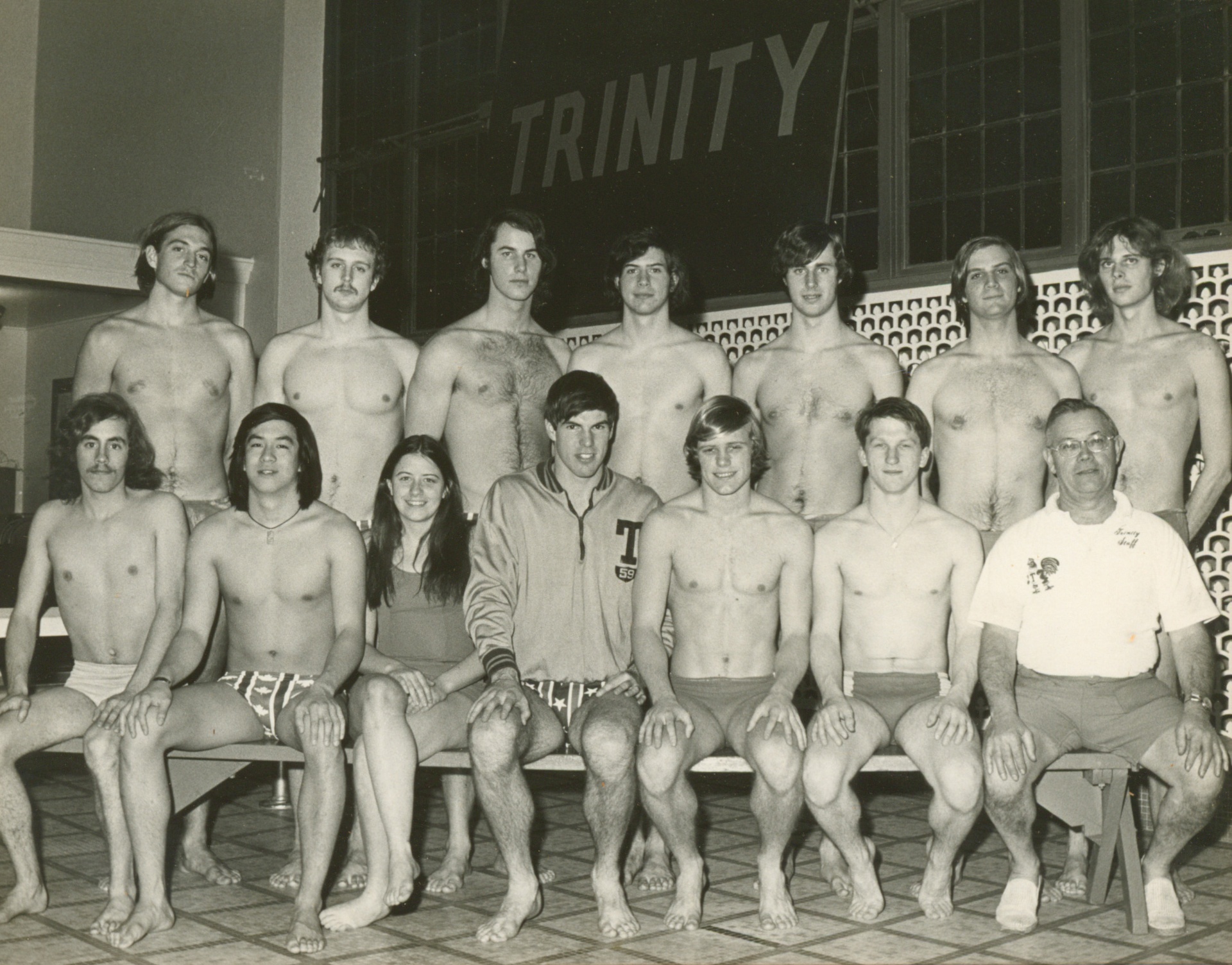
Barbara Clark '76 couldn't find a women's swim team when she arrived on Trinity's campus in 1972, so she joined the men's team as a diver. By her senior year, she had brought seven other women onto what had quietly become a co-ed team. Lanier Drew '80 couldn't find a women's cross-country team, so she ran with the men — and went on to compete in the 1984 U.S. Olympic Marathon Trials, the first one where women were allowed to compete. Sarah Koeppel '83 joined the men's varsity golf team because Trinity didn't have a women's program. Trinity still didn't have one until 2018 — thirty-five years later.
None of them gave speeches. None of them issued demands. They just showed up.
Every college has stories like these. Women who arrived before the infrastructure did, who made their own place, and whose names have often faded from the record books.
Every college has stories like this. Stories that predate the trophy cases and the highlight reels. Stories buried in old newspapers, in alumni memories, in archives that haven't been opened in decades. Most schools have no idea what's in there.
We do.
At College Sports History, we find those stories and bring them to life — through digital histories, documentaries, books, and events. Our flagship project, the Trinity College Athletics History, is live now at bantamsportshistory.com. Take a look.
Who were some of the women who showed up first at your school? We'd love to hear about them.
And if you're wondering what's buried in your own athletics history — let's have a conversation.