The College Kid Connection
From Penn to Montevideo, from Hartford to Los Angeles, from Saint Louis to the 2026 World Cup — college soccer has always played a part in America's biggest moments.
Summer 2026: The Captain Takes the Field
As the U.S. Men's National Team gets set to take on Belgium in the Round of 16, the American captain is Tim Ream: 38 years old, the oldest American ever to start a World Cup match, a center back who spent four full years at Saint Louis University (SLU). In an era when America's most gifted young players bypass college entirely — choosing European academies and professional development leagues instead — the man wearing the armband in one of the biggest matches in years took the college road all the way.
He isn't alone. Eight players on the 2026 U.S. roster carry at least some college soccer experience in their background: Matt Freese, who played at Harvard; Miles Robinson, who starred at Syracuse; Mark McKenzie, who spent a season at Wake Forest. Others came through UC Davis and Cal State Fullerton. The college pathway to the World Cup is narrower than it once was — but it hasn't closed.
The college connection to American soccer runs even deeper on the women's side — the U.S. Women's National Team has won the World Cup four times, and college soccer has long been its primary pipeline. That's a story for another post.
To understand what that means, you have to go back. Way back.
1905: How It Started
American college soccer has a specific birth year: 1905. That year, five schools formed the Intercollegiate Soccer Football League (ISFL) — the first organized governing body for the college sport in the United States. The founding members were Columbia, Cornell, Harvard, and two Philadelphia institutions that would become central to this story: Haverford College and the University of Pennsylvania.
The timing was not accidental. College soccer emerged partly as a safer alternative during a national crisis over deaths and injuries in college football. The game spread through the Northeast, the ISFL crowning annual champions through 1925. When Harvard and Yale threatened to resign citing scheduling disputes, the league dissolved and was replaced in 1926 by the Intercollegiate Soccer Football Association — the ISFA — which governed the sport through 1958. Then in 1959, the NCAA launched its first national championship tournament.
The inaugural winner: Saint Louis University — Tim Ream's alma mater — a program built on the deep soccer culture of St. Louis, a city that had been quietly producing American talent for decades.
Montevideo, 1930: The Lone Man from Penn
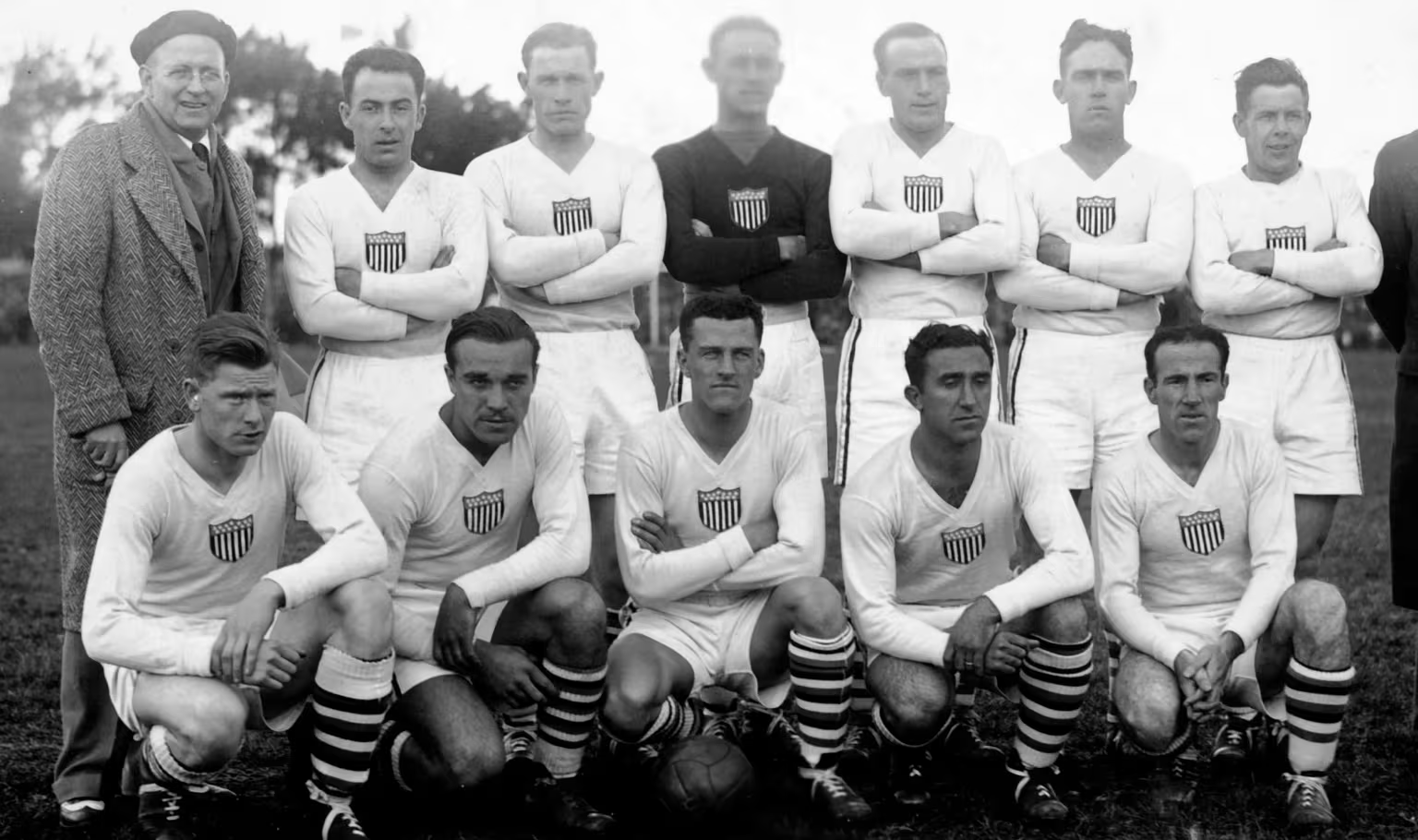
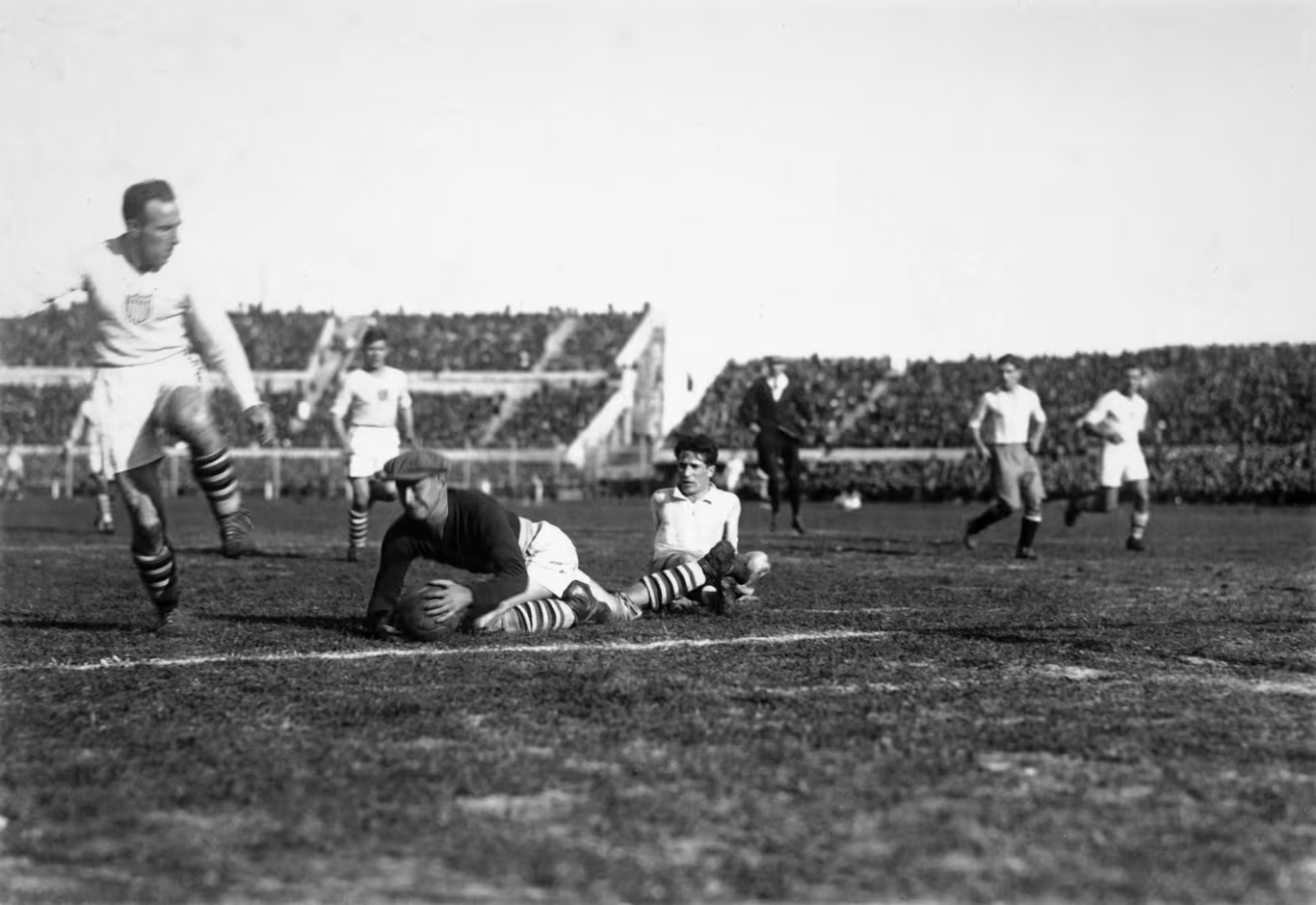
America's greatest World Cup performance is still the one almost no one remembers. In Uruguay, at the first-ever FIFA World Cup in 1930, the United States reached the semifinals and finished third — still the best American finish in the tournament's history. The U.S. team stunned Belgium 3–0 and demolished Paraguay 3–0 before falling to Argentina 6–1 in the semis, then claimed third place on goal difference after Yugoslavia fell to host Uruguay by the same score.
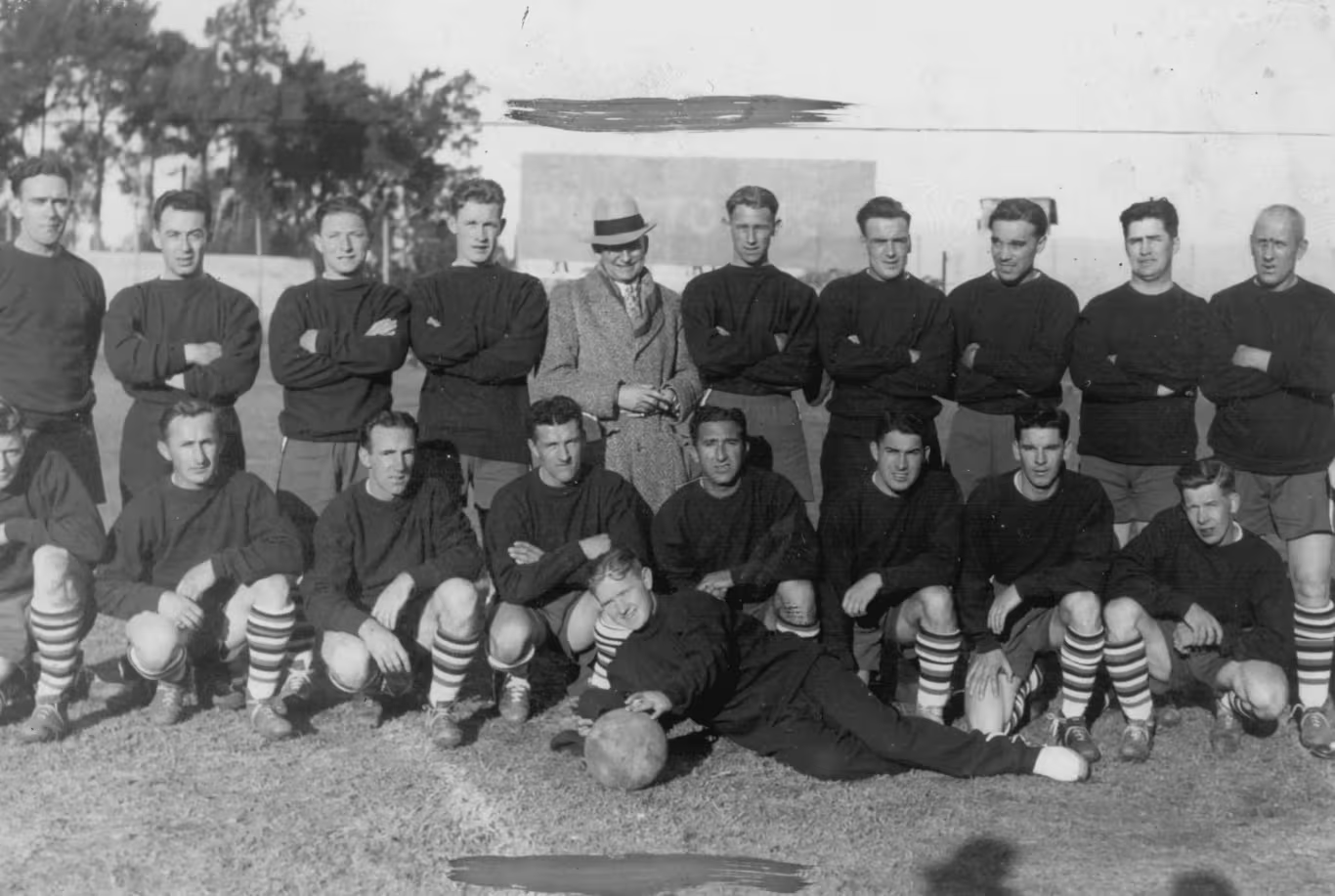
A persistent legend holds that the squad was assembled mostly from "ringers" from Scotland or England, imported to give America a respectable showing. FIFA historians have pushed back on this. Yes, six players had British origins, but most had emigrated to the United States as children, and only one had played professionally overseas.
Among them was one player unlike any other on the roster: James Gentle, a forward who had graduated with a bachelor's in economics from the University of Pennsylvania's Wharton School in 1926. FIFA's own account of the tournament notes that his inclusion on the squad seemed to be "as much for his ability to speak Spanish as his skills on the field." No one else on the squad could navigate a foreign country in its own language, communicate with tournament officials, help a team find its footing in an unfamiliar place. Gentle's Penn education had given him something the American Soccer League couldn't. College helped put him on that boat to Montevideo.
The story doesn't end in Uruguay. In 1935, Gentle became the head soccer coach at Haverford College — the other founding school of the ISFL. Over six seasons, he went 39–26–3 and won two conference championships. In 1986, he was inducted into the National Soccer Hall of Fame. One man. Penn Wharton undergraduate. World Cup semifinalist. Hall of Famer. Coach at one of the schools that invented American college soccer.
The College Kid from Edinburgh: Alex Guild, 1957–1960
Thirty years after James Gentle played at the World Cup in Uruguay, another college kid became the only college player on the 1960 U.S. Olympic qualifying squad. His name was Alex Guild.
In 1951, thirteen-year-old Alex stepped off a boat from Scotland. He had grown up on the Royal Mile in Edinburgh, playing street football with tennis balls, following his beloved Hibernian F.C., dreaming of becoming a professional player. His father had taken a maintenance job at a newspaper in Hartford, Connecticut, the Hartford Courant. Alex enrolled at Hartford Public High School, ran cross country, and played high-level club soccer with the New Britain Falcons in the Connecticut Soccer League — an immigrant-rich ethnic circuit that carried him to matches across New England.
Alex had expected to attend UConn, but a music teacher named Connie Weaver had other ideas. She pushed him to look at smaller liberal arts colleges and helped connect him with Hartford benefactors who funded his education at nearby Trinity College. He arrived as a scholarship student, joining a program that had remarkably just earned its own place in college soccer history.
In the fall of 1956 — just a year before Alex arrived — the Trinity College soccer team went undefeated — and the ISFA, the governing body that had overseen college soccer since 1926, named them the outstanding team in the country. Not the best small college team. The best college team, period. There was no NCAA tournament yet. Like college football before the playoff era, the national champion was determined by a committee selection rather than postseason play. Trinity and Brown were both undefeated; the ISFA chose Trinity. In 1957, Brendan Shea '59 appeared on the cover of the 1957 NCAA Soccer Guide — the college soccer world's formal acknowledgment that Trinity belonged at the very top of the game.
Four years later, Alex Guild would leave Trinity as the most productive player in the program's history — a distinction that, more than sixty years later, remains untouched.
Over four seasons as a center forward from 1957 to 1960, Alex Guild scored 58 goals, added 49 assists, and accumulated 165 career points. His goal total is 18 more than the second-highest in Trinity history. His assist total nearly doubles the next-best figure. He was a Division III All-American three consecutive years. In October 1959, he scored five goals against Union. The following day — against WPI — he scored five more and added seven assists: 17 points in a single match. The Williams College coach, watching Guild play, called him the best college player he had ever seen.
That same year, Guild was invited to the U.S. Olympic team trials in St. Louis. He earned selection to the qualifying squad and traveled to Los Angeles, where he played the full ninety minutes against Mexico in a 1–1 draw — in an era before substitutions, as the only college player on the team. The U.S. did not advance through the Americas qualifying rounds and did not reach the Rome Games. But the Edinburgh boy who almost went to UConn, who made it to Trinity because a music teacher believed in him, had represented his adopted country at the highest level the program reached.
Guild's full story — including an interview recorded in his own words — is part of the Trinity College athletics history digital platform and can be accessed here.
Full Circle: Saint Louis, 1959 and 2026
Here is a detail worth savoring. In 1959 — the same year Alex Guild was playing in Olympic qualifying — Saint Louis University won the very first NCAA men's soccer championship. Half a century later, Tim Ream played four years at Saint Louis University, was named the 2009 Atlantic 10 Defensive Player of the Year, and went on to build one of the most remarkable careers in American soccer history: years in the English Premier League and Championship, a late-career move to Charlotte FC, and ultimately the captain's armband at the 2026 World Cup.
The dominant path for elite American players today is the academy route — bypass college, sign professionally as a teenager, develop in Europe. That path has produced stars. But Tim Ream took the other road: four years of college, the full NCAA experience, a degree from an institution with deep roots in the game. And he ended up leading his country.
The Thread
From James Gentle to Alex Guild to Tim Ream: across nearly a century, there has always been a college program — and a college player — at the center of America's most important soccer moments. A Penn-trained interpreter who helped navigate a World Cup semifinal. A scholarship student from Edinburgh who arrived at that championship program and proceeded to shatter every record it had. A Saint Louis University center back who became his nation's oldest World Cup captain.
These are not obscure trivia. They are institutional stories — stories that live in athletic department files, yearbooks, alumni archives, and the memories of men and women who were there. Usually unseen. Usually unrecorded. Often forgotten.
That's exactly the history worth finding. Alex Guild's five-goal game against Union. James Gentle's interpreter's notebook in Montevideo. The 1959 Saint Louis University team that won it all. The records that still stand. The stories that still resonate.
College sports history is richer than most institutions realize. It just needs someone to go looking.
At College Sports History, we partner with college athletic departments to research, digitize, and publish the stories that define their programs. Let's have a conversation.