The Prince, the Streak, and the Team the World Sent to Claremont
How a seven-nation squad from a small liberal arts college ended the most dominant winning streak American college soccer has ever seen — and why almost no one knows about it.
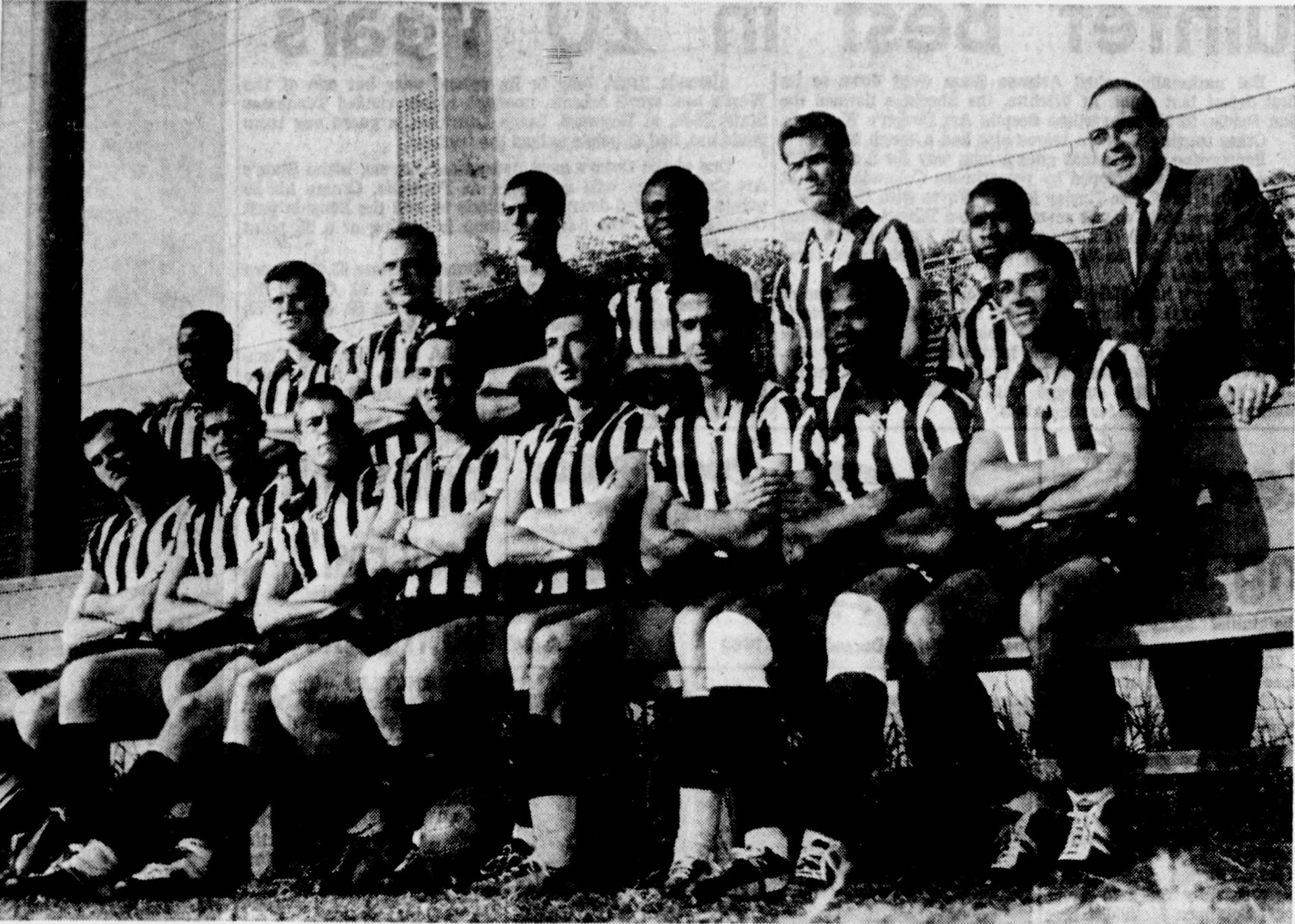
On a Saturday afternoon in the fall of 1962, six hundred people turned out to Alumni Field at Pomona College for homecoming. What they watched was one of the most remarkable upsets in the history of American college soccer. Pomona-Claremont — a combined team drawing players from Pomona College and its neighboring Claremont Men's College (now Claremont McKenna) — two of the Claremont Colleges, a cluster of independent schools that share a campus — beat UCLA 3-1, ending UCLA's 93-game unbeaten streak.
Now a couple caveats are important. First, UCLA men's soccer in 1962 was not what it is today, and not even what UCLA basketball and football were in the early 1960s. UCLA men's soccer did not join the NCAA until 1967.
Before then, it competed in a regional body called the Southern California Soccer Association, a loosely structured conference that included UC Riverside, Caltech, Biola, Redlands, Whittier, Cal Poly, and at various points even a team representing the U.S. Marines at San Diego.
But within that conference, the much larger UCLA dominated, led by a Scottish coach named Ed "Jock" Stewart. A professor at UC Santa Barbara, the late Arthur Sylvester — who earned his own MA and PhD at UCLA in the 1960s, right in the middle of the Stewart era — built an entire website dedicated to the legacy of Jock Stewart. Over roughly fifteen years at the helm, Stewart compiled a career record of 194 wins, 29 losses, and 12 ties — an 85 percent winning percentage — and won twelve conference titles. His rosters were genuinely international, a rarity at American colleges in that era: one 1962 article counted fourteen nationalities on a single UCLA squad.
The winning streak had begun after a 28-game run was snapped by Santa Ana City College in 1959, according to Sylvester's research. UCLA then went on an almost incomprehensible tear. Contemporary newspaper accounts from 1962 reported the streak at various lengths — 90 consecutive wins in one piece, "93 of its last 94 games" in another, 96 in a quote from the Pomona coach himself. The most specific figure — "93 of its last 94" — reads like a number pulled from a conference release and is probably the most reliable.
Whatever the exact count, the context is striking: the longest unbeaten streak in college soccer officially recognized by the NCAA stands at 65 games, set by Penn State between 1932 and 1941. The modern record, set by Indiana in 1983-84, is 46. UCLA's run — unofficial, unrecognized, and finally ended on a Pomona homecoming afternoon — would have dwarfed them both.
The Team the World Sent
Just two years before the 1962 championship season, Pomona-Claremont had finished last in the Southern California Soccer Association. The turnaround began under Mohy Quandour, who had been raised in Jordan and played professionally in Germany; in his first season, 1961, he took the team to second place behind a perfect 9-0 UCLA squad and was named Conference Coach of the Year.
Then, for 1962, something unusual happened. Don Blything — a 30-year-old British graduate student who had been the team's captain the year before — became its player-coach. He inherited a roster unlike anything the conference had seen. Contemporary coverage headlined it simply: "Unbeaten P-C Soccer Team Represents Seven Nations." England. Nigeria. Southern Rhodesia. Turkey. Saudi Arabia. British Guiana. And the United States.
The leading scorer was Korhan Berzeg, 22, a senior from Ankara, Turkey, who finished the year with 33 goals — a new league record — and served as co-captain alongside an American, John Sanger of Rancho Santa Fe. Third on the scoring list was Eghosa Osagie, a 21-year-old sophomore from Benin City, Nigeria, with 11 goals.
And then there was Bander Faisal.
Nineteen years old, an economics major at Pomona College, Bander — more formally, Bandar bin Faisal Al Saud — was the son of Crown Prince Faisal of Saudi Arabia. His father would become King Faisal two years later, in 1964. Bandar had attended the Hun School of Princeton before arriving at Pomona, spoke of having played soccer "as long as I can remember," and finished the season as the team's second-leading scorer with 23 goals.
In the homecoming upset against UCLA, he scored twice.
Bandar went on to a forty-year career in the Royal Saudi Air Force, retiring as a lieutenant general in 2007, and later became a businessman and environmental conservationist. His Wikipedia biography confirms his attendance at Pomona College. His name appears nowhere in the standard retellings of American college soccer history.
12-0-1
Pomona-Claremont opened the 1962 season 4-0 before the homecoming game against UCLA — 600 spectators, Alumni Field, a 3-1 final that stopped the Bruins cold. They would meet UCLA once more later in the season, this time to a 2-2 draw — the only game all year Pomona-Claremont didn't win outright. UCLA finished the year 10-1-1. Both blemishes — the one loss and the one tie — were against the same team.
Pomona-Claremont finished 12-0-1, Southern California Soccer Association champions, having outscored their opponents 84 goals to 14 across the season. Coach Blything, reflecting on the challenge of managing such a roster, offered one of the more memorable quotes of the year: "It's not easy for an American to get on a team like this."
The History That Didn't Get Written
In an earlier post on this site, we traced the roots of American college soccer and its surprising ties to the U.S. Men's National Team — a story rooted in the same 1950s and 60s era when the sport existed largely outside the structures that would later give it official shape.
The Pomona-Claremont story belongs squarely in that world.
Because UCLA's dominance happened outside the NCAA, Jock Stewart's dynasty has no official standing. The winning streak — 93 games, or 90, or 96, depending on your source — lives only in the clippings of Los Angeles and Claremont-area newspapers from 1962, and in the occasional alumni letter written decades later by someone who was there. Bandar bin Faisal Al Saud scored twice in the game that ended it, then went on to a career that no one following college soccer in Claremont that afternoon could have predicted. The team that beat UCLA, drawing players from seven nations and led by a British graduate student who had been its captain the year before, finished the season undefeated.
That's what happened. Almost nobody knows.
A New Voice for Pomona-Pitzer Soccer
Editor's note: I started down the Claremont-Pomona soccer rabbit hole because my son, Finn Callahan, who is working in LA, makes his sports broadcasting debut tomorrow as the new voice of Pomona-Pitzer soccer. Finn played soccer at Dartmouth and grew up a rabid Liverpool fan. You can watch him live on FloCollege Sports (requires a subscription…) at 10am PST/1pm EST Saturday as the Sagehens take on Linfield University.
I told Finn I would dig up some history on Pomona-Pitzer soccer, and this is what I found. Just goes to show, no matter where you look in the history of college sports, you find interesting stories. Another fun fact: do you know who else played soccer at the Claremont Colleges in the late 1960s? The actor Robin Williams spent his freshman year (1969–70) at Claremont Men's College — now Claremont McKenna — where he played on the soccer team that won the SCIAC title that season, before transferring away to pursue acting. As the story is often told, he later left Juilliard's advanced program early as well, reportedly after his teachers felt they had nothing left to teach him.
At College Sports History, we partner with college athletic departments to research, digitize, and publish the stories that define their programs. Let's have a conversation.