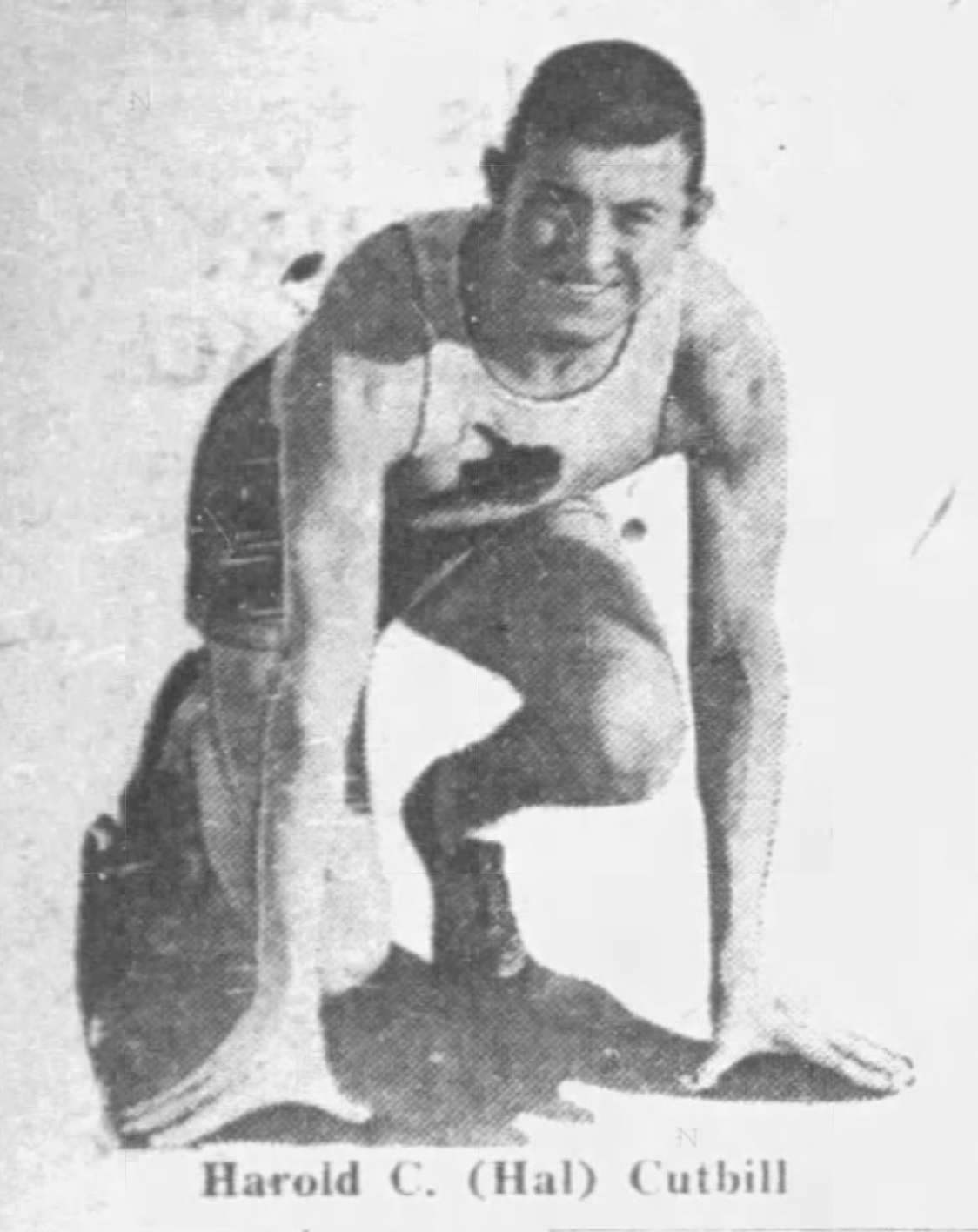
The Flying Parson
He may have been the fastest man in the world at his distance. Then a disputed $30 expense claim erased his world record and his Olympic dream — and the timing has never added up.
He became known as the "Flying Parson." Hal Cutbill, Wesleyan class of 1919, later a student at the Boston University School of Theology — a brilliant middle-distance runner who should have gone to the Olympics. He may have been the fastest man in the world at his distance. And his dreams may have been crushed not by a character flaw, not by fate, but by something more calculated: the politics of 1920s amateur athletics.
The Making of a Champion
Hal Cutbill led the 1919 Wesleyan track & field team to what the Hartford Courant called "one of the most successful seasons in the history of the institution." He set the school record in the half mile and won the New England Championship. The team went undefeated, defeating NYU, Brown, and Williams before finishing second in New England behind only MIT.
But it was Cutbill's career after Wesleyan that became something remarkable — and ultimately more tragic.
By the early 1920s, Hal Cutbill had become one of the fastest middle-distance runners in the world. Track was a much bigger deal then than it is today. Track stars were household names, sharing sports headlines with sluggers like Babe Ruth and heavyweights like Jack Dempsey. Thousands of fans packed track stadiums; millions more listened on the radio. And the Wanamaker Mile — run each year at the Millrose Games inside the original Madison Square Garden — was one of the biggest races of all.
That Garden was a palace. A colossal structure of white stone designed by architect Stanford White, it featured a 32-story tower modeled after the bell tower of the Cathedral of Seville, topped with an 18-foot copper statue of Diana, Goddess of the Hunt. It was the largest indoor arena in the world. If there was one place where a great runner could announce himself to the world, this was it.
In February 1920, few had heard of Hal Cutbill outside of New England. The favorite was Joie Ray — "Chesty Joie," the Kankakee Kid — who had won the Wanamaker Mile five years running. Ray was stocky and powerful; Cutbill was tall and lanky, his WWI draft form noting his build simply as "slender." When reporters learned that Cutbill was studying for the ministry at the Boston University School of Theology, the nickname wrote itself: The Flying Parson.
During the race, Ray was cruising toward what he expected to be victory number six when the roar of the crowd told him someone was on his heels. It was Cutbill. Ray had everything he needed to hold on — barely — but the message was clear to everyone in that packed stadium: Hal Cutbill could fly.
A Battle Bigger Than One Runner
What few in that crowd fully appreciated was that Hal Cutbill — as a product of Wesleyan University, trained within the college system — was running directly into a war he hadn't started.
Since the first modern Olympics in Athens in 1896, the Amateur Athletic Union had controlled virtually every aspect of American track and field, including Olympic team selection. The AAU was dominated by club athletes and urban athletic associations. But as American universities grew in size and prominence in the early twentieth century, the newly formed NCAA began pushing back. Colleges provided coaches, training facilities, and an increasing share of the country's best athletes. Why, the NCAA asked, should the AAU have sole authority over who goes to the Olympics?
By 1920, this battle was boiling. And Hal Cutbill, a college man through and through, was caught in the middle.
He qualified first in the regional Olympic trials at Franklin Field in Philadelphia in June 1920, and arrived at the national trials at Harvard Stadium in July as a legitimate contender. The top four finishers would make the team. Cutbill was expected to be one of them. He wasn't. The reasons were never fully explained. Afterward, believing he deserved a spot based on his times, Cutbill traveled to New York with his travel papers in hand, ready to board the ship to Antwerp if the Olympic committee called his name. The call never came. There was Hal Cutbill, sitting on a bench at Grand Central Station, waiting for a train back to Boston while Joie Ray and 250 other American athletes boarded a ship in Hoboken bound for Belgium and the 1920 Olympics.
The Rise, and Then
If Cutbill carried a chip on his shoulder after 1920, he showed it on the track. In January 1921, he beat J.J. Connolly in the Brooklyn 1000 — Connolly had been at Antwerp. A month later, back at Madison Square Garden, he came from behind to beat Joie Ray in the Wanamaker Mile, taking home the Rodman Wanamaker Trophy in a last-second flourish. Years later, Dartmouth's longtime track coach Henry Killman called that 1921 race between Cutbill and Ray the greatest race ever run at the Garden.
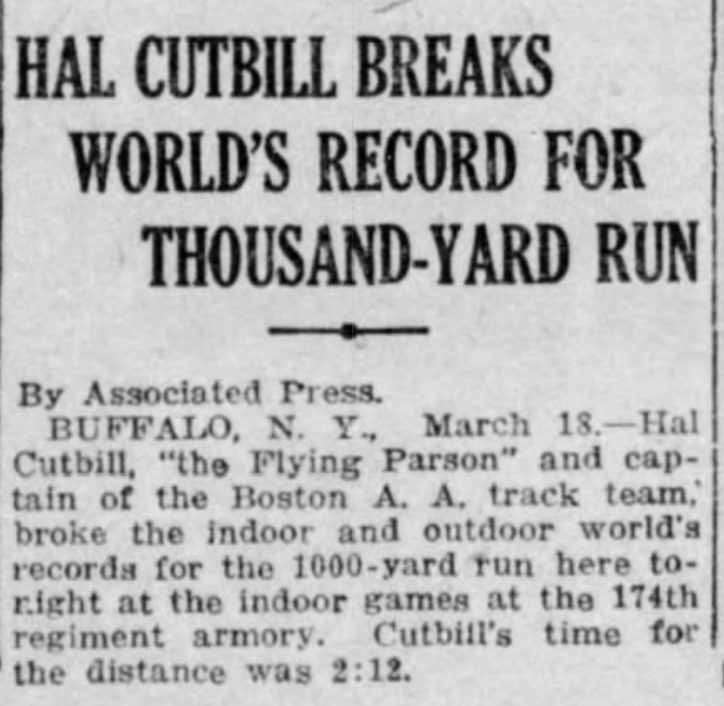
Cutbill was even better at shorter distances — the 1,000 yards or 800 meters, closer to a half mile. In 1922, he won the Brooklyn 1000 again, this time beating Connolly by ten yards and tying the world record. Then on March 19, 1922, he lined up at the 174th Armory in Buffalo for a 1,000-yard race that the sports pages were buzzing about: could Cutbill break the record outright?
He ran a "heady race," staying near the rear until the final laps before passing the field. When he looked up at the clock after crossing the finish line, it read 2 minutes, 12 seconds flat. The Flying Parson had just run 1,000 yards faster than any human being on earth.
The 1924 Olympics in Paris were beginning to feel inevitable.
The $30 That Changed Everything
Less than two weeks after his world record, on April 3, 1922, this headline appeared in the Buffalo Express: "Harold C. Cutbill, Star Athlete, Charged with Forfeiting Amateur Status."
Under the strict amateur rules of the era, athletes could be reimbursed for expenses — but nothing more. At a race in Hartford the previous February, Cutbill had asked for $60 in expense reimbursement. The event organizers said he could document only $30 in receipts. Cutbill — a student at a school of theology, a man of principle — insisted on the full amount. The AAU opened an investigation.
"I received no money but legitimate expenses," Cutbill told reporters. His coach, John Ryder, called the matter "mere technicalities." Even the local AAU president said he expected the charges to be refuted.
The AAU held a hearing on May 26, 1922 — the same day, as it happened, as Cutbill's graduation from the Boston University School of Theology. Cutbill chose his graduation. The hearing proceeded without him, and the next day Hal Cutbill was suspended from the AAU. His world record of 2:12 was erased from the books. And with the suspension, his path to Paris was gone.
Was It Really About the $30?
That question lingers. The infraction at Hartford took place February 28, 1922. Three weeks passed. Then Cutbill set the world record in Buffalo. Then, two weeks after that, the AAU announced its investigation. Why the delay? Why did a disputed expense claim go unaddressed until after Cutbill became the fastest man in the world at his distance?
It is worth remembering that the man running the AAU at the time was Avery Brundage — who would become infamous years later as the chief advocate for sending a U.S. Olympic team to Nazi Germany in 1936. Historian Joseph Turrini, in his book The End of Amateurism in American Track and Field, described Brundage as "the most virulent, oppressive, devoted, well-known, and despised supporter of amateurism in American sport." The AAU under Brundage made a habit of crushing athletes over minor transgressions. Jim Thorpe lost his 1912 gold medals because he had played semi-professional baseball the previous summer. Joie Ray himself would be suspended in 1926 for appearing in an automobile advertisement.
And Hal Cutbill was, above all else, a college man — trained within the university system that the AAU viewed as a rival for control of American athletics. Whether the $30 dispute was the real reason for his suspension, or merely a convenient one, is impossible to know with certainty. But the timing raises questions that were never answered.
What Might Have Been
In 1927, the AAU quietly lifted Cutbill's suspension without explanation. In 1929, his record of 2:12 was restored to the books, where it stood until 1935 when it was broken by Glen Cunningham, considered one of the greatest American runners of the twentieth century. The New York Times noted: "The burly Kansan removed from the record books one of the oldest marks of them all: Hal Cutbill's figure of 2:12."
At the 1924 Paris Olympics — the Games Cutbill should have run — a British runner named Douglas Lowe won the 800 meters. The runners who competed in Paris that summer were later immortalized in the 1981 film Chariots of Fire, which won the Academy Award for Best Picture.
Hal Cutbill is not in that movie.
If we apply Cutbill's record-setting 1,000-yard time of 2:12 to the slightly shorter 800-meter Olympic distance, his pace would have won the gold medal in Paris by a full second — and set a new world record.
Hal Cutbill went on to a successful career in ministry and later in business. He raised a family in Connecticut and, by all accounts, lived a good life. He died on July 27, 1975, at the age of 77. July. The same month he sat on a bench at Grand Central Station in 1920. The same month the Paris Games took place in 1924.
The Flying Parson. He could run faster than anyone alive. And he lost it all — his records, his Olympic dream, his place in history — over a disputed $30 expense reimbursement.
Or maybe that's not really what it was about at all.
Wondering what's buried in your own athletics history? Let's have a conversation.