Soccer Style is for Soccer
A dusty size-15 kicking shoe, a 63-yard record that stood for 28 years, and the long, strange history of the foot in football — from dropkicks worth more than touchdowns to the day the toe kicker went extinct.
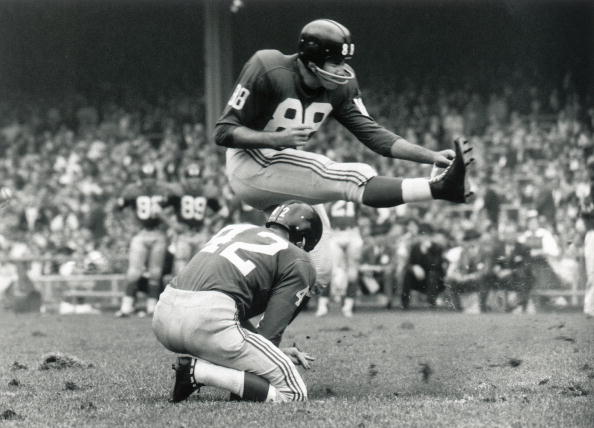
When I played youth football, there's nothing I enjoyed more than kicking. From Pee Wee to High School, I always played both ways, running back on offense and corner back on defense, but I loved doing kickoffs, extra points, and the occasional field goal. Keep in mind, I kicked the old-fashioned way. The right way. Really the only way to kick a football. Straight on.
After all, soccer style is for soccer.
Soccer style never made sense to me. How can you kick the ball as far with the side of your foot than with your toe? Doesn't your leg move back-and-forth better and harder in a straight arc than swinging it from the side?
But even by the time I was playing in the mid to late 80s, straight-on kicking was on the demise. Soccer style was taking over.
The first college football kicker to employ the "soccer style" technique was Pete Gogolak at Cornell, who kicked a 41-yard field goal on October 28, 1961 — and in doing so, changed the sport forever.
From there, it steadily grew. The last straight-on kicker in the NFL was Mark Moseley of the Washington Redskins, who retired after the 1986 season. His final kick in an NFL game came on January 11, 1987, in the AFC Championship. He was also, improbably, the only kicker ever to win the NFL MVP award — which he did in 1982, kicking straight on. Take that soccer style!
Keep in mind that for many years — even well after the ascendance of soccer style — it was a straight-on kicker who held the NFL record. Tom Dempsey of the New Orleans Saints booted a 63-yarder on November 8, 1970, as time expired to beat the Detroit Lions 19-17. The kick was longer than the previous record by seven yards and stood for 28 years until Jason Elam of the Denver Broncos tied it in 1998. Matt Prater broke it with a 64-yarder in 2013, and Justin Tucker pushed it to 66 yards in 2021.
In the college ranks, straight on kickers are essentially extinct. At every level of college football today — from Power Four programs to Division III — you will not find a single toe kicker on a roster. The style died out completely by the early 1990s, and no one has seriously revived it since.
When "Foot" Ball Meant What It Said
Kicking, of course, played a critical role in the early years of the sport that would, after all, become known as "foot" ball. But it took decades before anything resembling the modern incarnation of kickoffs, field goals, and extra points would take shape.
The first intercollegiate football game was played on November 6, 1869 — Rutgers versus Princeton — and it looked far more like rugby than anything we'd recognize today. Teams advanced the ball primarily by kicking it. In those earliest days, you could kick the ball downfield to your own players. Think of it like a punted ball that your own team was racing to recover — essentially a rugby "up-and-under," translated onto American soil. Even the ball was rounder. It was only as Walter Camp formalized the line-of-scrimmage system through the 1880s that football gradually shifted away from pure kicking and toward the running and passing game we know today.
In those early decades, the dropkick was king. Drop the ball, let it bounce, boot it on the rise. Simple, effective, and the standard method for field goal attempts for the first quarter-century of the sport. In fact, when Walter Camp pushed through the first formal point system in 1883, a field goal was worth five points, while a touchdown was worth only four. Kicking wasn't just important — it was the most valuable play in the game.
The placekick for field goals didn't arrive until 1896, when two brothers at Otterbein College in Ohio wrote a letter to Walter Camp proposing a new technique: snap the ball to a teammate, place it on the ground, hold it steady, and kick. Camp confirmed it was legal. Princeton adopted it enthusiastically — so enthusiastically that it became known, somewhat unfairly to the Otterbein brothers, as the Princeton Place Kick.
Dropkick field goals remained common for decades after that, but the writing was on the wall. In 1934, the NFL slimmed down the football to make it easier to throw. The new shape made drop-kicking unreliable — the bounce became too unpredictable. The last successful drop-kicked field goal in NFL history came on December 21, 1941, when Ray "Scooter" McLean of the Chicago Bears split the uprights with one in a regular-season game.
The extra point has an even stranger history. In the very earliest days of the sport, after a touchdown — which was initially worth almost nothing on its own — the scoring team earned the right to a "free kick": an essentially uncontested dropkick at goal, with the opposing defense lined up passively behind the goal line. In a real sense, the kick after the score was actually the main event. The scrimmage-based snap, hold, and kick that we recognize today didn't arrive until 1922, when rules placed the ball at the five-yard line for a live play from scrimmage. By 1924, it had moved to the three-yard line, where it has more or less stayed ever since.
As for kickoffs, those evolved from something even stranger. For many years after a team scored, they didn't kick off to the other team — they punted the ball to them. The receiving team could then try to catch it and attempt a free kick at goal of their own. It was only in the 1890s, as the dribble-kick and the infamously violent Flying Wedge formation were outlawed, that something like the modern kickoff took shape. And the kicking tee — that humble rubber wedge that every placekicker takes for granted today — wasn't even permitted until 1948.
So, the next time someone complains that football has drifted from its roots, remind them: for the first several decades of the sport, "foot" ball actually meant what it said.
The Herman Munster Shoe
Before my junior year football season in high school, in the summer of 1985, I decided to go down to my local sports store and see if I could buy a kicking shoe. Yes, that's right, we straight-on kickers had our own special shoe. It looked like a regular football cleat in the back but in the front was a block of wood covered in leather and was squared off flat at the end. It was a bit like tying your foot to a two-by-four, which was kind of the idea.
The sports store guy had one left, perhaps the last kicking shoe sold in America. He pulled it off a high shelf, blew off the dust, and soon it was mine. I'm pretty sure it had been made in the 1950s. It was a size 15. We came to call it the Herman Munster shoe.
But that Herman Munster special booted a 42-yard field goal to win the game against our rival, Immaculate Conception (IC). After the game, the long-time and somewhat legendary coach of IC told a local newspaper reporter that I had "done everything but drive the bus" in that game. Technically, that was not accurate. It was a home game for us, and so I didn't need to drive.
A Lesson from a Bear
By some quirk of fate, the legendary Chicago Bears kicker, Bob Thomas — who became the Bears' all-time leading scorer — came to work for my father, who was a lawyer outside Chicago, as Bob made his transition from the NFL to the law. Bob Thomas would later serve as a longtime Justice on the Illinois Supreme Court, at one point serving as Chief Justice. It may have helped that both Bob and my dad were Notre Dame grads.
Bob Thomas had grown up playing soccer and so he learned the very wrong way of kicking a football, which was soccer style. And he took that crazy style of kicking to booting the winning field goal on New Year's Eve 1972, to lead Notre Dame over Alabama in the Sugar Bowl, 24-23, then had a nine-year run with the Chicago Bears, retiring as their all-time leading scorer.
And do you know what I did with my straight-on kicking style? Did I tell you about the 42-yarder I put up against IC?!…
Anyway, while Bob Thomas was working for my dad, we decided to arrange a little day of kicking instruction. I was in high school at the time. This was the chance. Finally, I was going to learn the "other" form of kicking, apparently the better way, soccer style. We found some local high school field and Bob gave me all the pointers and we tried and tried and tried again. Finally, after about an hour, Bob said, "You know what, just keep kicking straight on." And then he added, "In fact, it's really the only way to kick a football."
Ok, maybe he didn't say that last part. But still, let's all agree…
Soccer style is for soccer.
At College Sports History, we partner with college athletic departments to research, digitize, and publish the stories that define their programs. Let's have a conversation.