Playday Champions
The first intercollegiate women's ice hockey game was played at Colby in February 1973. Or was it? A reader tip led to Marjorie Bither, a 1956 yearbook, and a whole hidden era of competition no one was allowed to call competition.
The first intercollegiate women's ice hockey game was held at Colby's Alfond Rink in February 1973, between Colby and Brown. Or was it?
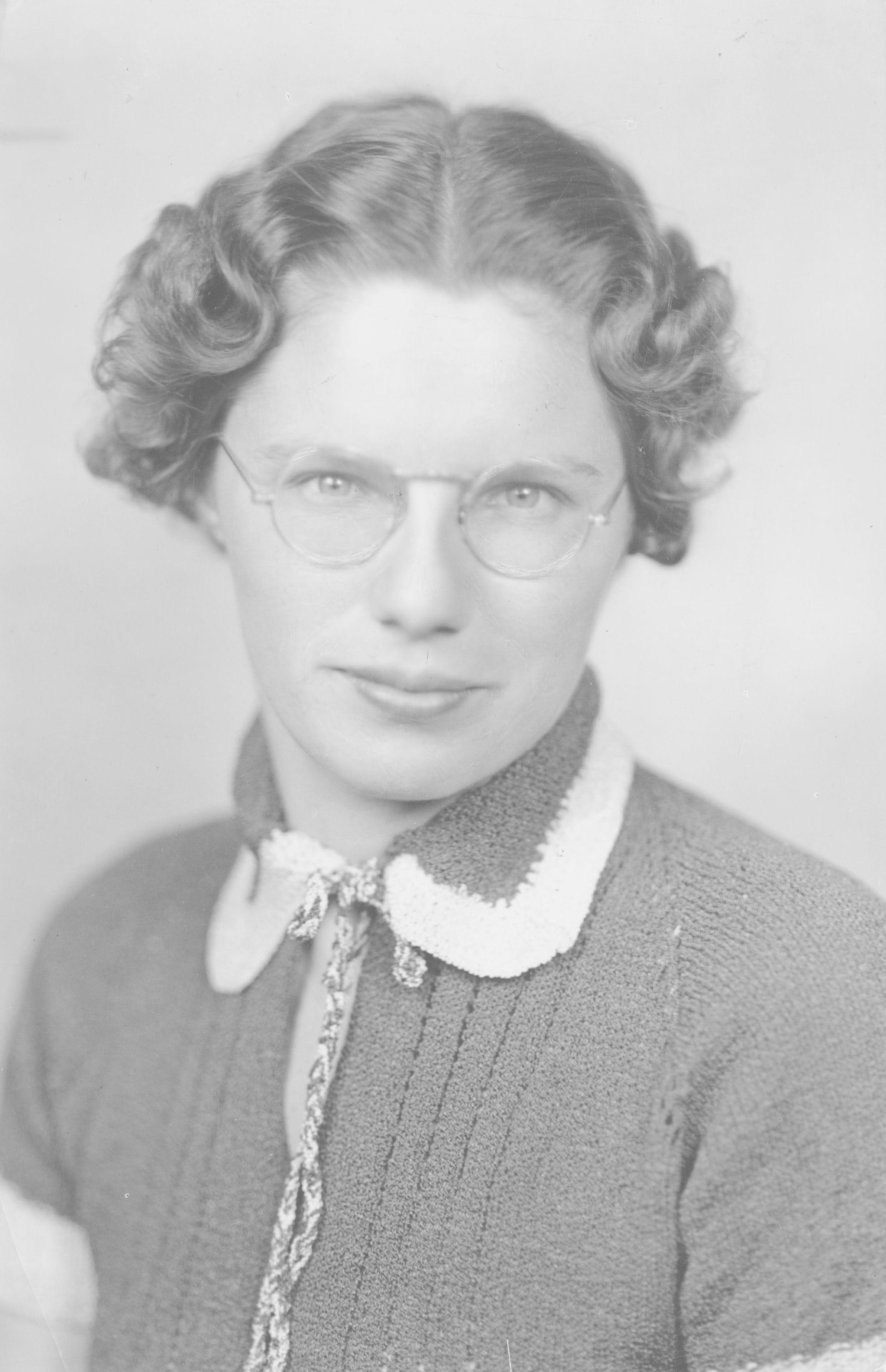
The question leads us to Marjorie Bither — and to a reader tip that opened a rabbit hole worth falling into. Steph Fawell, a recent Colby grad and diver from Santa Monica, CA, shared with us the remarkable story of Bither, a woman who spent four decades shaping women's athletics at Colby and in the northeast more generally. Steph won the Marjorie Bither Award in 2021, which prompted her to learn more about this amazing woman.
The Woman Behind the Ice
Bither was, in all but title, the first female athletic director of a coeducational college in America — and Colby is quite proud of that. In 2022, the administrative suite in Colby's Harold Alfond Athletics and Recreation Center was named in her honor. Mike Wisecup, Colby's vice president and director of athletics at the time, said it simply: "We should be proud of being at the forefront of some important changes in athletics."
Colby has a long history of firsts when it comes to women. It was the first all-male New England college to go coeducational — which it did back in '71. That would be 1871, not 1971, when most of its peers made the same move. And it was Bither herself who joined Colby's physical education department as early as 1936, long before women's athletics was a serious institutional priority anywhere.
And yet even at Colby, the story of women's athletics for most of the 20th century is one of limits. As a recent article about Bither put it, women's sports at Colby until the late 1960s "were part of the physical education program and exclusively intramural at the time." The article continued that "progress toward women's intercollegiate play 'was excruciatingly slow,'" quoting Earl Smith, the College's historian, in his book Mayflower Hill.
It was Bither who played a central role in finally bringing intercollegiate competition to Maine colleges in the late 1960s and early 1970s, even before Title IX. She assembled the Maine Association for Intercollegiate Athletics for Women in 1966 and became its first president. Under her watch, varsity field hockey and basketball formed in 1968, tennis in 1969, swimming in 1970. By the time she retired in 1979, Colby had achieved gender equity with 14 teams for both women and men.
A Word that Hid Everything
But it was looking back at the 1956 Colby yearbook that I learned about the concept of a "playday."
"The spring also saw many girls at the University of Maine for the spring sports inter-collegian playday."
Inter-collegian. Playday. To understand the history of women's college athletics, you need to understand both of those words — and the tension between them.
The reasons women's intercollegiate competition was suppressed for so long are both practical and ideological. In the late 1800s, women's basketball — introduced at Smith College in 1892, as we learned from a previous blog post — became so popular that students were clamoring to play other colleges. Female physical educators pushed back hard. They had watched men's college sports become commercial, elitist, and obsessed with winning, and they were determined to protect women's athletics from the same fate.
In 1923, the Women's Division of the National Amateur Athletic Federation adopted a formal platform calling for broad participation over competition, discouraging individual records and championships. Their motto: "every girl in a sport and a sport for every girl."
By the 1920s, women physical educators were effectively unanimous in their opposition to intercollegiate sports for women, and that philosophy dominated college campuses for decades. It wasn't until 1957 that the governing body for women's sport amended its long-standing policy to say that intercollegiate programs "may" exist. Notably, that is the same year Marjorie Bither returned to Colby full-time.
Into this climate was born the "playday." By 1936, 70% of American colleges used playdays as the primary form of athletic participation for women, according to Joan Hult in her influential article, "The Story of Women's Athletics: Manipulating a Dream 1890-1985," in Women and Sport: Interdisciplinary Perspectives (1994). The word "manipulating" in the title captures the whole dynamic.
Technically Intercollegiate
According to Hult, the playday format was carefully designed to give administrators cover. Players from different schools would be mixed together into color teams — no school jerseys, no school affiliations — so that no one could accuse the event of being real intercollegiate competition.
However, not everyone followed the rules to the letter. The University of Wisconsin's own archives describe playdays as "technically intercollegiate" events that were "wildly popular," precisely because they threaded this needle: students could compete hard against opponents from other colleges, while faculty could rest assured that no one would be "morally deformed by an overabundance of team spirit."
There was also a variation called a "sports day," where school rosters stayed intact — closer to what we would recognize today as a tournament. And here is where the official version of history starts to fray.
Did these events represent real intercollegiate competition, however unofficial? The evidence says yes. At the University of Wisconsin, the 1933 yearbook reported that "intercollegiate competition is the chief attraction of the Archery Club," which competed against Smith, Sweet Briar, and Mount Holyoke in national intercollegiate tournaments — with scores submitted by telegraph! Officially intramural. Unmistakably competitive.
You can get a sense of this by reading old newspapers. In her "Women in Sports" column, Hazel LeMoine of the Portland Press Herald wrote on December 2, 1956:
"Delegates of the Gorham State Teachers College who recently attended the Farmington State Teachers College Playday grabbed volleyball and basketball round robin laurels."
You have to read between the lines — but clearly, "delegates" of one college played against delegates of another, and one of them walked away as champions. No scores given, but someone kept score, and a champion was declared. There are many other examples of this for both high school and college "playdays" and "sports days" for women.
Seventeen Years Early
Which brings us back to that 1956 Colby yearbook. Elsewhere in the Women's Athletic Association section, it notes: "The W.A.A. sponsored a hockey playday and clinic which included representatives from nearby colleges. Ann Townsend, noted hockey player, gave the group some hints on how to improve hockey techniques."
Representatives from nearby colleges. At a hockey playday. In 1956. Seventeen years before the "first" intercollegiate women's ice hockey game.
So, was the February 1973 game between Colby and Brown the first women's intercollegiate ice hockey game? Almost certainly — because that was when it was officially allowed. It was the first game that anyone was permitted to call a real game.
But was it the first time women hockey players from Colby suited up, represented their college, and played against women from another school? Perhaps not.
To understand the history of women's college athletics, you must understand playdays. And to understand playdays, you won't find much in the stat sheets or the record books. Only if you can read between the lines will you find much in the newspaper.
The only way to truly capture the history of playdays — to know what it felt like to load into a car with your teammates, drive to another college, and compete for a championship that no one was officially allowed to call a championship — is to find and talk to the women who were there.
Wondering what's buried in your own athletics history? Let's have a conversation.