3-2, And a Hundred Years of History Behind It
A reader's correction sent us back to the archives — and uncovered a century of women's ice hockey that America forgot: Mount Holyoke in 1896, the Pembroke Pandas in disguise, and the 1973 Colby team that restarted it all.
We love it when we hear from readers, even when — and especially when — they point out something we got wrong. In a previous blog post, we wrote about the first women's intercollegiate ice hockey game in 1973 between Colby and Brown at Colby's Alfond Rink.
We also suggested that Colby women may have been playing ice hockey even earlier, and that indeed according to the 1956 Colby yearbook, women began "skating" immediately upon the opening of the Alfond Hockey Rink that year, and two years later hosted a "skating" playday at Bates.
But Susan Cook wrote to us — a Colby graduate of 1975 and a founding member of that women's ice hockey team in 1973 — and pointed out that the reference to Anne Townsend and "hockey" in the same 1956 yearbook is most certainly a reference to "field" hockey and not "ice" hockey, as women were not playing ice hockey at that time.
And "skating" at the Alfond Rink and at the playday at Bates seem to be just that: skating, and not ice hockey. Thank you Susan for your clarification. And certainly that 1973 game was the first intercollegiate women's ice hockey game. We also left out the lead in our first blog post: Colby won that game 3-2. Congratulations to Susan and her Colby teammates!
But speaking of women's ice hockey, it does have a long and rich tradition that precedes that first intercollegiate game in 1973.
The Early Wave Nobody Remembers
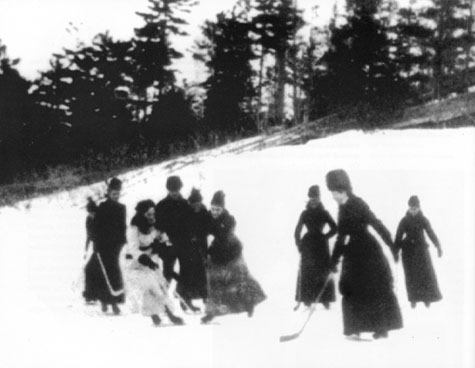
As far back as 1896 — 77 years before that Colby-Brown game — women at Mount Holyoke College were photographed skating with ice hockey sticks in the school's newly built John D. Rockefeller Skating Rink. A women's match between teams from Ottawa and Philadelphia was reported in the Ottawa Citizen in 1899. By 1907, there's a photograph of an all-women's team in Hannah, North Dakota, the Hens, who were playing against men's teams.
This wasn't a fluke. It was the beginning of something real.
By the mid-1910s, organized women's ice hockey had taken root across the country. Boston, New York, Pittsburgh, Philadelphia, San Francisco, Seattle: all had confirmed women's clubs. In December 1916, the Boston Girls' Hockey Team held tryouts at the Boston Arena and the news spread as far as Cleveland. That same month, the New York Times reported on the St. Nicholas Blues playing the Manhattan Reds at the St. Nicholas Rink, tied 1-1 in front of a crowd. In 1921, a Seattle women's team called the Vamps played in the world's first international women's hockey tournament alongside clubs from Vancouver and Victoria, British Columbia.
In other words: women's ice hockey in America was very much alive.
And Then It Wasn't
The 1920s ended it. If you have been reading our previous posts, you know the story. The National Amateur Athletic Federation, the governing body for women's sport, adopted a philosophy that women should "play for play's sake," meaning no competition. Combined with the Great Depression, which closed rinks, and World War II, which did the rest, women's ice hockey essentially vanished from the American sports landscape for 40 years.
The same forces that gave us the playday — the conviction that competitive sport would make women "masculine and unbecoming" — wiped out what had been a genuinely thriving game.
The Woman Who Sneaked into Practice
In September 1964, a freshman named Nancy Schieffelin arrived at Pembroke College, the women's college within Brown University. She had grown up in New Jersey playing ice hockey, and she had no intention of stopping.
The Brown men's hockey coach, Jim Fullerton, spotted her fooling around with a puck and a stick one day at the school's new rink. He was intrigued enough — and apparently his team was struggling enough — that he invited her to attend a practice. Disguised as a man.
After that practice, Schieffelin went directly to Arlene Gorton, Pembroke's Director of Physical Education, and proposed a women's ice hockey team. Gorton agreed. The Pembroke Pandas, as they would come to be known, formed around 1966 and are recognized as the first varsity women's college hockey program in America.
Their budget was essentially nothing. Players wore hand-me-down Pee Wee jerseys and helmets, field hockey shin pads, and blue jeans. With no other collegiate programs to play, they scraped together games against faculty, spouses, and a Rhode Island men's club team. In the late 1960s, they sold chocolate bars to charter buses to Canada to play Canadian collegiate women's teams, because that was the only competition to be found.
That is the level of determination it took to restart women's ice hockey in America.
The Road to Colby
In 1971, Cornell freshman Reggie Baker recruited 23 women for a women's ice hockey team. She had been planning this since eighth grade, when she had approached her science teacher, Gail Murphy, about coaching it someday. Baker distributed fliers around Cornell during her senior year of high school. When she finally got to campus, the athletics office refused to give the team ice time because they weren't an official varsity sport. The team spent their entire first season doing off-ice conditioning at Schoellkopf Field.
The following year, with the help of her father, a Cornell professor, Baker got the team recognized as a varsity sport. They finally got on the ice.
And in February 1973, Colby hosted that first intercollegiate women's ice hockey game. Against Brown, the Pembroke Pandas, the same program that had been selling chocolate bars to find opponents a few years earlier. Colby won 3-2.
After That
Once the door opened, it flew off the hinges. Title IX had passed in 1972, and schools began scrambling to add women's sports. Providence went varsity in 1974-75. Yale and New Hampshire in 1977-78. Harvard in 1978-79. Dartmouth, Wesleyan, and RIT not far behind. Williams and Colgate both had club teams by 1973, the same year as that Colby-Brown game.
By the late 1970s, there was enough critical mass in New England that the women's Beanpot held its first edition in 1979.
The first national championship for women's college hockey wasn't held until 1998. The same year, the U.S. women's team won gold at the Nagano Olympics, the first time women's ice hockey was ever played at the Games.
That gold medal team was built almost entirely on a generation of players who grew up because of what women like Nancy Schieffelin, Reggie Baker, and the founding Colby players made possible.
Susan Cook and her teammates didn't just play an ice hockey game in February 1973. They helped restart a tradition that had gone dormant for half a century and set in motion everything that came after.